
Quick Answer
Past life regression hypnotherapy is a guided relaxation technique where a trained hypnotherapist brings you into a deeply focused, trance-like state and invites you to recall images, sensations, or scenes that can feel like memories from another life. A typical session with Sandeep Jain runs 60 to 90 minutes and moves through an intake conversation, an induction, a guided exploration, and a grounding period before you open your eyes. Whether those scenes are literal past lives or symbolic material surfacing from your own subconscious is genuinely debated, and no clinical body treats them as verified history. Most clients still describe the process as emotionally clarifying, and it’s meant to sit alongside your existing medical or mental health care, not replace it.
Key Takeaways
- A session usually runs 60 to 90 minutes: intake conversation, induction, guided exploration, then a slower grounding period before you leave the chair.
- You stay conscious the entire time. Hypnosis is a narrowed, relaxed focus, not sleep or a blackout, and you can open your eyes or speak up whenever you want.
- Mainstream psychology doesn’t treat the scenes people recall as verified historical memories; most researchers describe them as imaginative or symbolic material shaped by the subconscious mind.
- People tend to book this work when they’re stuck on something repeating, a fear with no clear origin, a relationship pattern, or a physical sensation that talk therapy hasn’t fully untangled.
- Most people explore a specific theme in one to three sessions rather than an open-ended series, though some return later for a different question entirely.
- This is complementary work. It sits beside medical or psychiatric care and never replaces a diagnosis, medication, or ongoing therapy for a mental health condition.
What Is Past Life Regression Hypnotherapy, Really?
Past life regression is a specific application of hypnotherapy. Instead of using trance to quit smoking or manage exam nerves, the hypnotherapist guides your attention backward, past childhood, past birth, and asks whatever comes up to surface on its own. Some people land on a vivid, story-like scene. Others get a feeling, a color, a single image that doesn’t resolve into anything cinematic. Both outcomes are normal, and neither one is a failure.
It’s easy to confuse this with the stage hypnosis you might have seen at a wedding or a corporate event, where someone clucks like a chicken on command. That’s a performance built on suggestibility and social pressure. A regression exploration session is quieter and slower, closer to guided meditation with a very specific destination in mind. If you want the fuller picture of how these sessions are structured at Blessings Revitalize, the regression exploration service page walks through what’s covered before you ever book a slot.
What Actually Happens Once You’re in the Chair?
The first ten to fifteen minutes rarely feel like anything is happening. Sandeep usually starts with a short conversation about why you’re there, because the direction of a regression session changes depending on whether you’re chasing a recurring nightmare or just curious. Then comes the induction: slower breathing, a body scan from your feet upward, your jaw and shoulders unclenching one at a time. Most clients say this part feels like the ten minutes before sleep, not sleep itself.
Somewhere between minute fifteen and minute twenty, the language shifts from relaxation cues to a visualization, often a staircase, a doorway, or a long corridor that represents moving backward in time. People report a range of sensations here: warmth spreading through the chest, a floating feeling in the hands, occasionally a sudden clarity that surprises them mid-session. From there, the exploration itself usually takes twenty to forty minutes, with Sandeep asking simple, open questions rather than leading you toward a specific answer. The last ten minutes are grounding, bringing your attention back to the room, your breath, the weight of your body in the chair, before you’re asked to open your eyes.
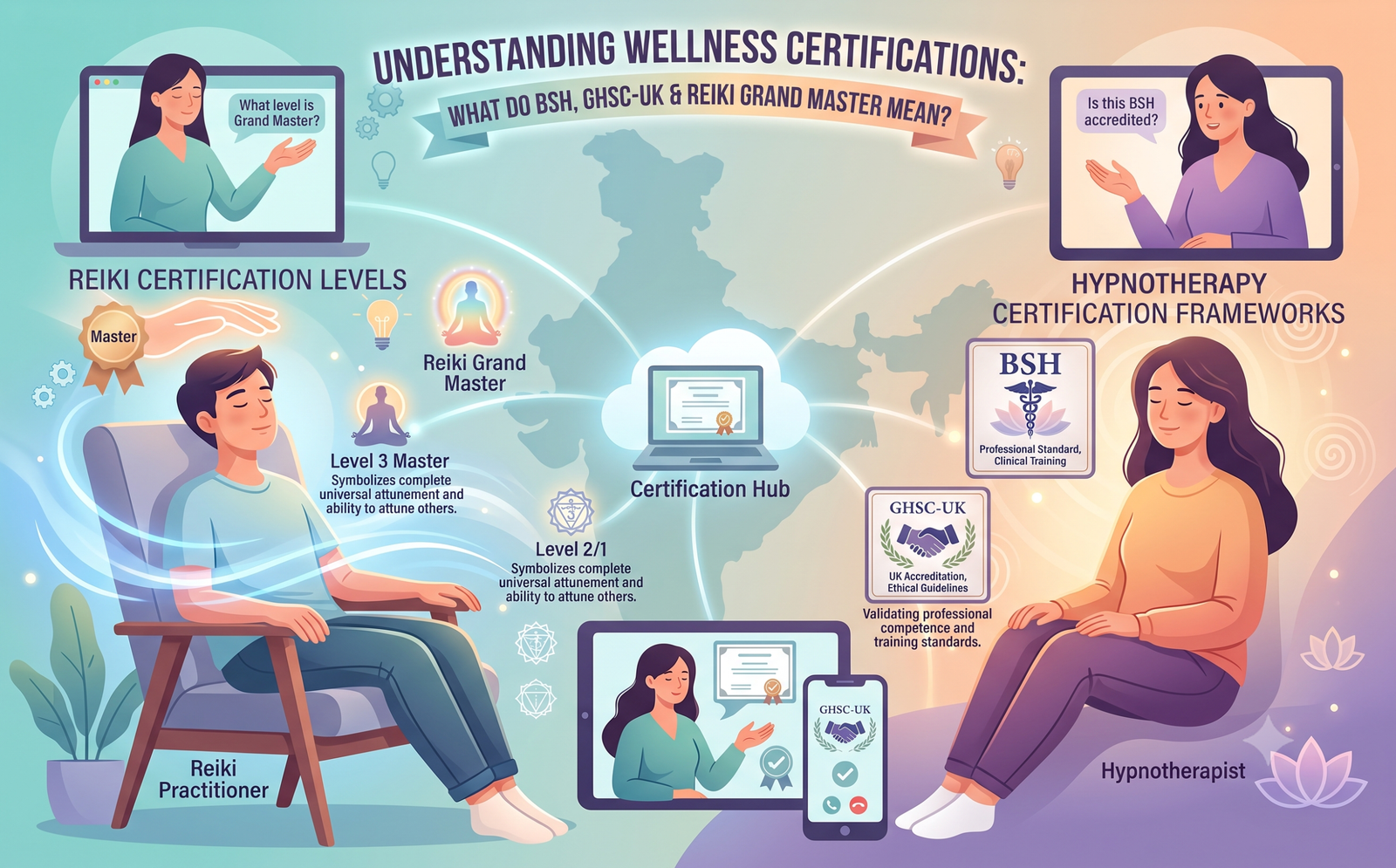
Sandeep trained through BSH and GHSC UK before adding Reiki Grand Master training on top of his hypnotherapy background, and that dual training is part of why regression sessions here tend to include an energy-awareness component that a purely clinical hypnotherapist might skip. If you want to see exactly what those credentials mean and where they came from, there’s a full breakdown on the credentials page.
Are These Memories Real Past Lives, or Something Else Entirely?
Here’s the honest answer, because a wellness site that dodges this question isn’t doing you any favors. No peer-reviewed research confirms that scenes recalled under hypnosis are literal memories of a prior life. The mainstream clinical view, echoed by professional hypnosis organizations, is that hypnosis is a real, measurable state of focused attention and relaxation, but that memories retrieved under it (past life or otherwise) can be shaped by imagination, expectation, and the way questions are asked. The American Psychological Association’s overview of hypnosis research is a useful, non-sensational place to read about what’s actually been studied.
What that means in practice: treat what surfaces as meaningful material worth sitting with, not as verified fact about a previous incarnation. Plenty of clients find the symbolic reading just as useful, a “past life” of feeling abandoned might really be pointing at something from this life that’s easier to look at from a safe emotional distance. Sandeep is upfront about this framing before a session starts, rather than promising proof of anything.
Who Actually Books This Kind of Session, and Why?
The people who tend to get the most out of regression work aren’t chasing a dramatic story. Most arrive with something specific and stuck: an unexplained phobia (heights, water, a particular sound), a relationship pattern that repeats with different people, or a physical tension that doctors haven’t found a cause for. A smaller group comes purely out of curiosity, often after reading about it or hearing a friend’s experience, and that’s a fine reason too.
It’s worth saying plainly that this isn’t positioned as a cure for anything. If you’re dealing with a diagnosed anxiety disorder, depression, or trauma, this kind of session is complementary and isn’t a replacement for medical or mental health treatment, and Sandeep will say so directly if that’s what someone is looking for it to be.
How Many Sessions Do You Need, and What Does It Actually Cost?
Most people explore a single theme, a specific fear, a specific pattern, in one to three sessions. There’s rarely a reason to commit to an open-ended package upfront. Cost and exact session length in Gurgaon and across Delhi NCR follow the same structure as Sandeep’s other hypnotherapy work, which is broken down in detail on the hypnotherapy cost and process guide, including what a first appointment typically involves before you decide whether to continue.
Sessions run online across India, so location isn’t really a barrier the way it might be for in-person specialty work. What matters more is timing: giving yourself a quiet hour afterward rather than booking a regression session on your lunch break and rushing into a meeting.
Frequently Asked Questions
Is past life regression scientifically proven?
No. There’s no scientific confirmation that scenes recalled under hypnosis represent literal past lives. Hypnosis itself is a studied, real phenomenon; what you experience under it isn’t independently verifiable as historical fact, and any reputable practitioner will tell you that upfront.
Will I definitely experience something during the session?
Most people do, whether that’s a full scene, a fragment of imagery, or just a feeling. Hypnotic depth varies from person to person, and a small number of people find it hard to relax into the process on a first attempt. That’s not a failure, and a second session often goes differently.
Can I get stuck in the trance or lose control of myself?
No. You remain aware throughout and can open your eyes, speak, or stop the session at any point. Hypnosis is closer to focused daydreaming than sleep, and nobody has ever gotten permanently “stuck” in it.
Is this a substitute for therapy or medication?
No, and it shouldn’t be treated as one. This work is complementary, meant to sit alongside any medical or mental health treatment you’re already receiving, not instead of it. If you’re managing a diagnosed condition, keep your doctor or therapist in the loop.
How do I prepare for an online past life regression session?
Find a quiet room where you won’t be interrupted, wear something comfortable, and avoid scheduling anything demanding right after. A stable internet connection and headphones make the guided part easier to follow.
How many sessions will I actually need?
Most clients explore a specific theme in one to three sessions. There’s more detail on typical session counts and pricing in the cost and process guide, and you can also book a session directly if you’d rather just start with a conversation about what you’re hoping to work through.
Written with input from Sandeep Jain, hypnotherapist (BSH, GHSC UK) and Reiki Grand Master, Blessings Revitalize, Delhi NCR.