
Quick Answer
Reiki and therapy solve different problems, so the honest answer depends on what you’re actually dealing with. If you have a diagnosed condition like depression, PTSD, or an anxiety disorder, therapy should be your first call, with Reiki used alongside it for relaxation and nervous system support, not instead of it. If what you’re facing is more about stress, low energy, or feeling disconnected from yourself without a clinical diagnosis attached, Reiki on its own may be exactly the right fit. The two aren’t competing for the same job. They work on different layers of the same person, and a lot of people end up using both.
Key Takeaways
- Reiki works with your body’s energy and nervous system through gentle hands-on or distance healing; therapy works with your thoughts, patterns, and past experiences through structured conversation.
- If you have a clinical diagnosis such as depression, PTSD, or an anxiety disorder, a licensed therapist should be your first call. Reiki can sit alongside that care, never in place of it.
- A Reiki session usually costs less than a round of talk therapy, but therapy is built to resolve root-cause patterns in a way Reiki never claims to on its own.
- Plenty of people use both at the same time: therapy for the mental and emotional processing, Reiki for the physical tension and nervous system reset that talking alone doesn’t always reach.
- Reiki is not a licensed clinical practice, so there’s no equivalent to a therapist’s training requirements or professional accountability. That matters if what you actually need is clinical treatment.
What Reiki Actually Does (and Where It Stops)
Reiki is a hands-on or distance energy practice. During a session, the practitioner works with your body’s energy field, usually while you lie down and simply breathe, to help your nervous system shift out of a stress response and into something closer to rest. Sandeep Jain has worked with clients across Gurgaon, Noida, and online across India for years, and the pattern he sees most often is people arriving tense, scattered, or exhausted, and leaving noticeably calmer. That calm is real. People feel it in their shoulders, their breathing, and often their sleep that night.
What Reiki doesn’t do is diagnose anything or walk you through why a pattern exists in the first place. It isn’t designed to unpack a childhood wound, challenge a distorted thought, or treat a clinical condition the way medication or structured therapy can. Sessions here are always offered as complementary support alongside professional medical or mental health care, never as a replacement for it, and that line matters more than most wellness websites are willing to admit out loud.
What Therapy Actually Does That Reiki Isn’t Built For
A trained therapist works with your thoughts, your history, and your behavior patterns directly, usually through structured conversation over weeks or months. Depending on the approach, that might mean cognitive behavioral therapy for anxiety, trauma-focused work for PTSD, or longer-term talk therapy for patterns that go back decades. A therapist can also diagnose, which matters legally and practically if you need documentation for anything from workplace accommodations to medication.
According to the National Center for Complementary and Integrative Health at the NIH, current clinical research hasn’t established that Reiki produces measurable effects beyond relaxation in controlled studies, which is exactly why it’s never positioned here as a substitute for diagnosed treatment (nccih.nih.gov/health/reiki). Therapy, by contrast, has decades of outcome research behind specific modalities for specific conditions. That’s not a knock on Reiki. It’s just a different tool solving a different kind of problem, and conflating the two does a disservice to anyone genuinely struggling.
The Real Trade-offs: Cost, Time, and What Each One Actually Asks of You
Here’s where the comparison gets practical, because the two really do differ in what they cost you, in money and in time.
| Factor | Reiki | Therapy |
|---|---|---|
| Typical cost per session | Generally lower, and widely covered on our own Reiki and hypnotherapy pricing page | Usually higher per hour, sometimes partially covered by insurance or employer wellness benefits |
| What it’s built to address | Stress, tension, low energy, general nervous system regulation | Diagnosed conditions, trauma processing, long-standing thought and behavior patterns |
| Time commitment | Often felt in a single session, though a short series works best | Usually weeks to months of consistent sessions for lasting change |
| Who delivers it | A trained Reiki practitioner, not a licensed clinician | A licensed, clinically trained mental health professional |
If you’re trying to decide purely on value, it helps to actually look at whether Reiki is worth the investment for what you specifically need, because the answer changes depending on whether you’re managing everyday stress or something that needs clinical attention.
Ready to see what a session actually feels like before deciding anything? You can book an online Reiki session with Sandeep and judge the calm-versus-cost question for yourself, with no obligation to treat it as a substitute for care you may already need elsewhere.
When Using Both Together Makes the Most Sense
The clients who get the most out of this combination are usually already in therapy, or starting it, and adding Reiki as a way to manage the physical side effects of stress and processing between sessions. One pattern Sandeep sees repeatedly: someone doing solid trauma work in therapy but still waking up at 3am with their chest tight, their mind racing through the same three worries. Therapy addresses the why. Reiki, in that gap between appointments, gives the nervous system somewhere to land.
It also works the other way. Someone managing a relationship conflict or ongoing anxiety might be in Reiki sessions for the calm, and realize partway through that there’s a deeper pattern worth bringing to a therapist, maybe through our own emotional and psychological support sessions or an outside clinician. Either direction is fine. What matters is not asking either one to do a job it was never built for.
Signs You Should Start With One Before the Other
If you’ve been diagnosed with something, or strongly suspect you should be, start with a licensed professional. That includes anything involving suicidal thoughts, self-harm, substance dependency, or a mental health crisis of any kind. Reiki is not equipped for that, and no honest practitioner should ever suggest otherwise.
If what you’re carrying is more diffuse, chronic work stress, a general sense of being overwhelmed, trouble sleeping, or just wanting to feel more like yourself again without a specific diagnosis attached, Reiki is a reasonable place to start on its own. A lot of people in Delhi NCR come to Sandeep for exactly this kind of thing: not in crisis, just worn down, and looking for something that helps without requiring a long clinical process first.
What an Actual Session Looks Like With Each
A Reiki session with Sandeep, whether online or in person, usually runs about 45 to 60 minutes. You lie down or sit comfortably, he works with your energy field either through gentle touch or at a distance, and most people describe warmth, tingling, or just a deep settling feeling. There’s no homework, no forms to fill beforehand beyond a short intake.
A therapy session looks quite different. You’re talking the whole time, usually guided by specific questions or exercises tied to whatever modality your therapist uses, and you’ll often leave with something to think about or practice before the next appointment. Neither format is better. They’re just doing different work, and knowing that going in saves a lot of wasted expectation on either side.
Frequently Asked Questions
Can Reiki replace therapy?
No, and this is the most important thing to understand before booking either one. Reiki can support relaxation and nervous system regulation, but it isn’t a substitute for diagnosis or treatment of a clinical mental health condition. If you’re dealing with something like depression, PTSD, or a diagnosed anxiety disorder, a licensed therapist needs to be part of the picture.
Will my therapist mind if I also do Reiki?
Most therapists are fine with clients adding complementary practices like Reiki, as long as it’s not replacing the actual clinical work. It’s worth mentioning to your therapist that you’re doing it, mostly so they have the full picture of what’s supporting you between sessions.
How many Reiki sessions equal one therapy session in effect?
There isn’t really a conversion rate here because they’re not measuring the same thing. Reiki tends to shift how your body feels in the moment; therapy works toward longer-term change in thought and behavior patterns. Comparing session counts directly doesn’t capture what either one is actually doing.
Is Reiki covered by insurance the way therapy sometimes is?
Generally no. In India, Reiki is typically an out-of-pocket wellness expense, while some therapy costs may be partially covered depending on your insurer and plan. Worth checking your own policy rather than assuming either way.
Can an online Reiki session really do anything, or does it need to be in person?
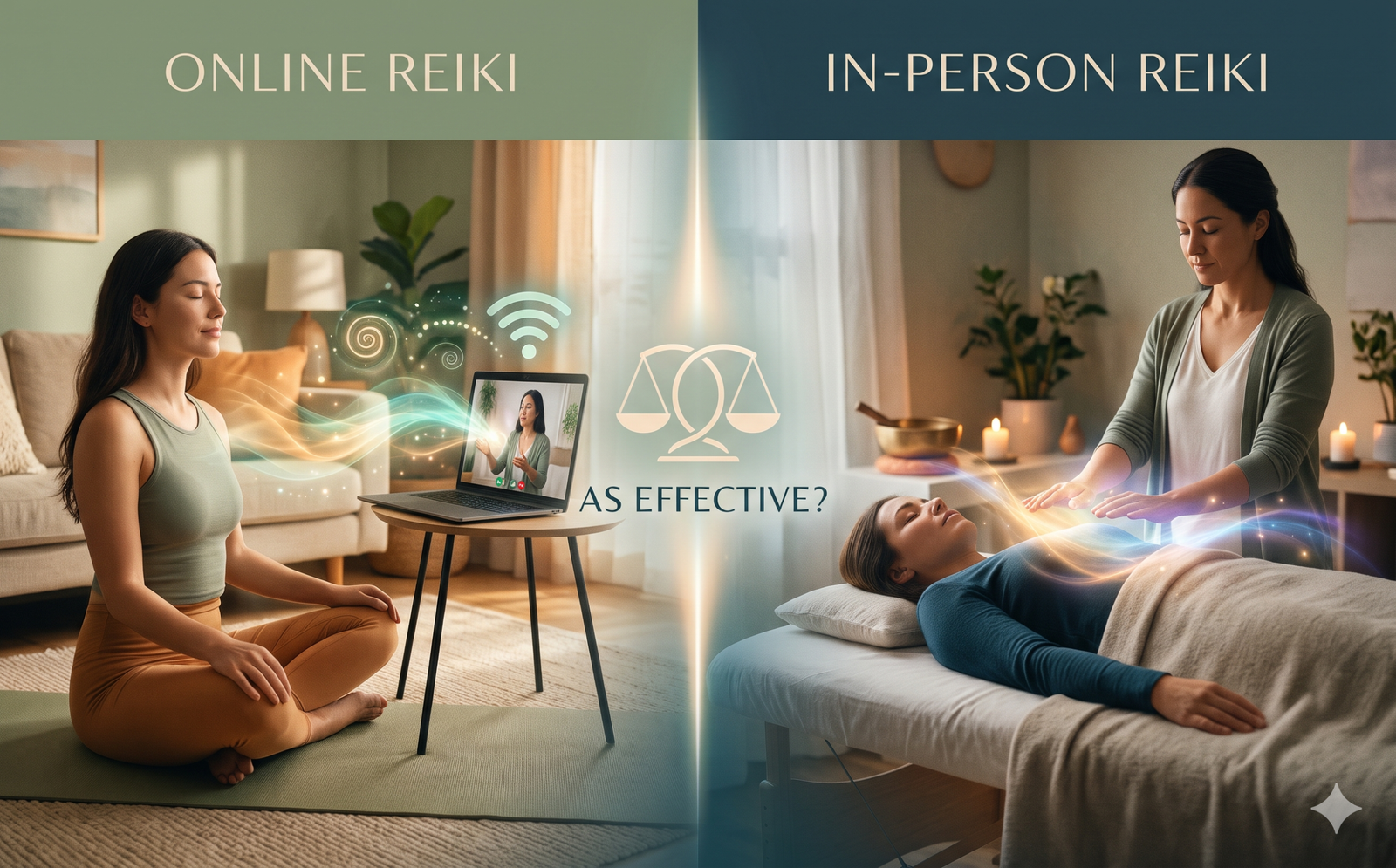
Online sessions work on the same principle as in-person ones and many clients find them just as effective, though it comes down to personal preference in some cases. There’s more detail on exactly how the comparison plays out in our piece on how online Reiki compares to an in-person session.
If you’re still weighing which direction makes sense for where you’re at right now, the easiest next step is usually just a conversation. You can message Sandeep directly on WhatsApp and describe what you’re dealing with, and he’ll tell you honestly whether Reiki fits or whether you’d be better served starting with a therapist first.
Written by Sandeep Jain, Reiki Grand Master and certified hypnotherapist (BSH, GHSC-UK), who has worked with clients across Delhi NCR and online across India for over a decade. Sessions are offered as complementary wellness support alongside, never in place of, professional medical or mental health care.