Quick Answer
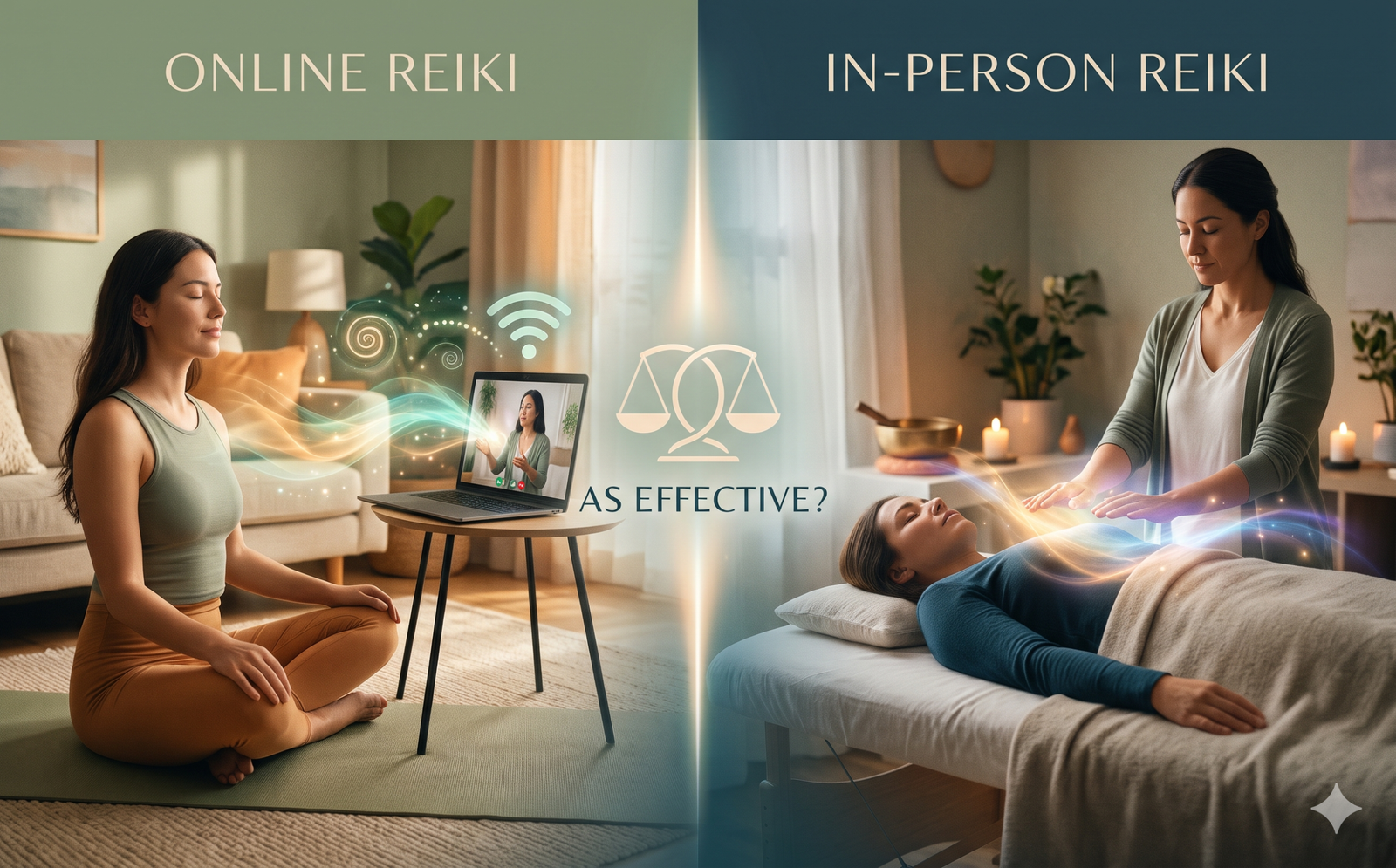
For most of what people actually come to Reiki for, easing stress, calming an overactive nervous system, and supporting emotional release, online and in-person sessions work through the same underlying process and tend to land in a similar place. The real difference isn’t effectiveness so much as experience. In-person adds a shared room, a practitioner’s hands-on read of where your body is holding tension, and a built-in pause from your day that a screen can’t fully recreate. Choose based on what actually fits your schedule and comfort level, not on an assumption that one format is doing “real” healing while the other is a watered-down substitute.
Key Takeaways
- Reiki practitioners work from the premise that the energy they’re channeling isn’t bound by physical proximity, so distance on its own isn’t treated as a barrier to the technique.
- Online sessions remove travel time entirely and let you receive a session from your own bed or sofa, which plenty of clients find deepens relaxation rather than limiting it.
- In-person sessions give a practitioner direct physical cues, muscle tension, breathing changes, where your shoulders are locked up, that a video or phone call simply can’t convey.
- Clinical research on Reiki as a whole is still limited and mixed, and that caveat applies about equally to both formats, so be wary of anyone promising a guaranteed outcome either way.
- Cost and scheduling usually favor online sessions, especially if you’re juggling Gurgaon traffic and work hours, or you’re simply outside driving distance of a practitioner you trust.
- The more useful question usually isn’t “which format is more effective,” it’s “which one will I actually show up for and stay consistent with.”
What Actually Happens Differently in an Online Reiki Session
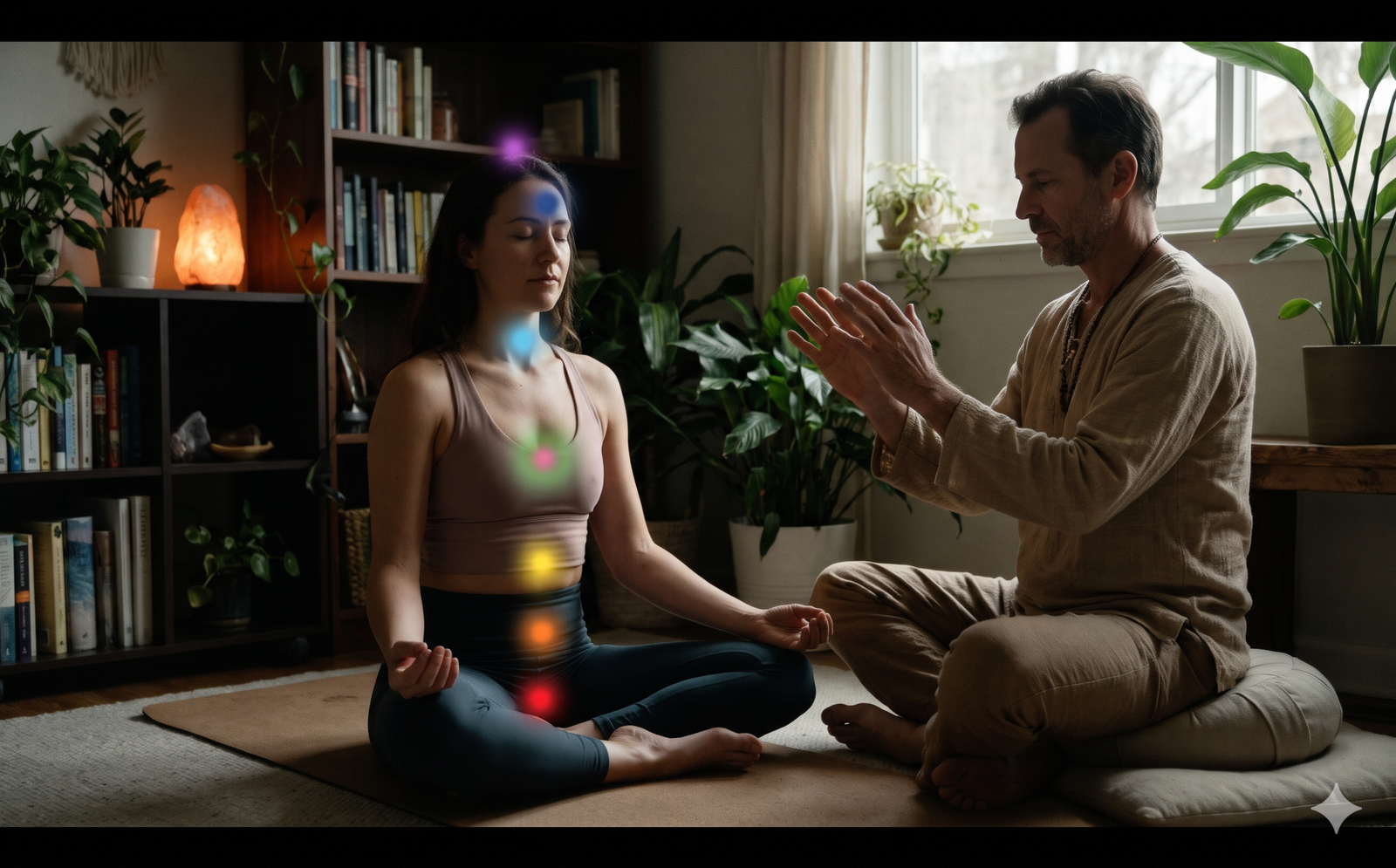
In an in-person session, a practitioner typically has you lie down and works with light touch or hands held just above the body, moving through a sequence tied to the major energy centers. Online, that physical sequence gets replaced by intention and visualization. Sandeep works through online Reiki healing sessions with clients across Delhi NCR and the rest of India, usually starting with a short check-in call about what’s going on physically and emotionally, then guiding you to settle somewhere quiet while he works. Some practitioners use a photo for a visual anchor. Others, Sandeep included, rely more on verbal check-ins during and after the session to track what shifted.
What doesn’t change is the underlying premise behind Reiki itself, that it isn’t a hands-on massage technique but a way of directing energy, and most lineages have always held that this can be done at a distance. That’s a belief system, not a settled scientific fact, and it’s worth being upfront about that rather than dressing it up as proven.
Online Reiki vs In-Person Reiki: A Side-by-Side Look
Here’s how the two formats actually compare on the things that tend to matter most to someone deciding between them.
| What You’re Weighing | Online Reiki | In-Person Reiki |
|---|---|---|
| Travel and logistics | None. Session happens wherever you are. | Requires getting to a clinic or practitioner’s space, often during traffic hours. |
| Practitioner’s physical read of you | Limited to what you describe verbally. | Direct, through touch and visible body language. |
| Environment | You control it. A familiar, private space. | Controlled by the practitioner. Often more ritualized. |
| Typical cost | Generally lower, no space overhead for the practitioner. | Often somewhat higher. |
| Scheduling flexibility | Easier to fit around work and family. | Tied to the practitioner’s clinic hours and your travel window. |
| Best suited for | Stress, anxiety, sleep, emotional processing, ongoing maintenance sessions. | Clients who want the physical ritual of being touched or specifically prefer in-room presence. |
Where In-Person Genuinely Has an Edge, and Where It Doesn’t
It would be dishonest to pretend there’s no difference at all. If you’re dealing with a specific area of chronic physical tension, say a shoulder that’s been locked up for months, a practitioner’s hands can find and work that spot in a way a phone call can’t. There’s also something to be said for the ritual of physically going somewhere for your own care, which some people find matters more than they expect going in.
Where in-person doesn’t actually have much of an edge is in the stress, anxiety, and emotional-processing work that makes up most of what people book sessions for in the first place. The mechanism Reiki practitioners describe, working with the body’s energy field rather than its muscles directly, doesn’t require the practitioner’s hand to be in the room. If you want to go deeper on the theory behind this, how distance Reiki actually works on a technical level walks through the symbol and the non-local framing practitioners use to explain it. It’s worth saying plainly that Reiki research overall, in-person or distance, is still thin. The National Center for Complementary and Integrative Health notes that while some small studies suggest Reiki may help with relaxation and symptom management, the evidence base is limited and more rigorous research is needed before firm conclusions can be drawn either way.
Who Actually Does Better With Each Format?
People who travel often, work long or unpredictable hours, or live outside Gurgaon, Noida, Faridabad, and Ghaziabad entirely tend to do better with online sessions simply because consistency matters more than any format difference, and online is what they’ll actually keep. People managing a specific, localized physical complaint sometimes feel more settled with in-person work, at least for the first session or two, before deciding whether to continue that way or switch.
If you’re still unsure what a session even involves, what to actually expect in an online Reiki session breaks down the practical side, from how long a call runs to what you might feel during and after. None of this is a substitute for medical or mental health treatment. If you’re dealing with a diagnosed condition, ongoing pain, or a mental health concern, Reiki and energy work sit alongside professional care, not in place of it.
Frequently Asked Questions
Does the distance between me and the practitioner actually matter for how well Reiki works?
Not according to how practitioners describe the technique itself. Reiki is framed as working with energy rather than physical contact, so most lineages treat distance as irrelevant to whether the technique can be applied, though this is a belief held within the practice rather than something settled by controlled research.
Is there real scientific proof that online Reiki works as well as in-person?
No, and that caveat applies to in-person Reiki too. Research on Reiki generally remains limited in scale and quality, with no large body of rigorous studies comparing online and in-person formats head to head. Anyone claiming certainty either way is overstating what’s actually known.
How does a practitioner know where to focus energy if they can’t see or touch me?
Through conversation. A good online practitioner asks specific questions before and sometimes during the session about where you’re holding tension or what’s been going on emotionally, and uses that to guide the session rather than guessing blind.
Is online Reiki usually cheaper than in-person sessions?
Generally, yes. Without a dedicated treatment space to maintain, online sessions tend to run a bit lower in cost than comparable in-person work, though pricing varies by practitioner.
Can online Reiki help with physical pain the same way in-person sessions can?
It can help some people, particularly where tension is linked to stress or nervous system dysregulation, but a highly localized physical issue may genuinely benefit from a practitioner’s hands-on read, at least to start. This is still complementary support, not a replacement for medical evaluation of ongoing pain.
How do I know if an online Reiki practitioner is actually legitimate and not just a phone call with no real training behind it?
Ask directly about certification and lineage, how long they’ve practiced, and what a session typically looks like before you book. A practitioner who answers plainly, without vague mysticism standing in for actual credentials, is usually a better sign than one who doesn’t.
If this has you leaning toward trying it rather than debating it, the format matters less than just starting somewhere you’ll actually stick with. You can book an online Reiki session directly and judge the rest from there rather than from a comparison chart.
Written by Sandeep Jain, Reiki Grand Master (GHSC-UK) and BSH-certified hypnotherapist, founder of Blessings Revitalize, Delhi NCR.