Quick Answer
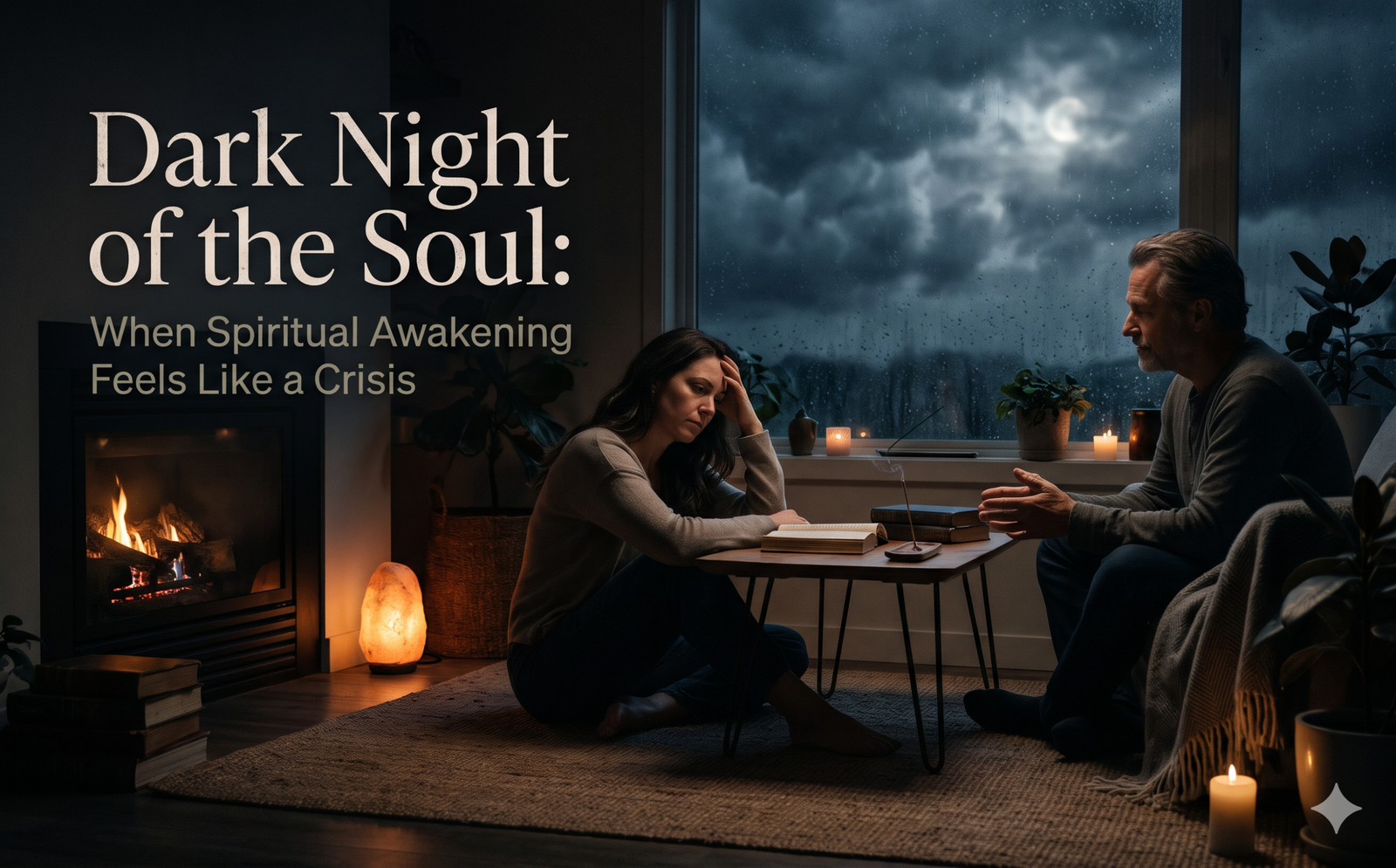
The dark night of the soul is a period of deep disorientation, grief, and loss of meaning that sometimes shows up partway through a spiritual awakening, not a sign that something has gone wrong. It tends to arrive once old beliefs, identities, or coping patterns stop working but before anything new has taken their place, which is part of why it can feel more like a crisis than a breakthrough. It is not a clinical diagnosis and does not replace treatment for depression or anxiety, though the two can overlap and are worth telling apart with help from a mental health professional if the low mood is severe or lasting. For most people it eases within weeks to a few months, and gentle support, including energy healing, rest, and talking to someone who understands the territory, tends to help more than pushing through it alone.
Key Takeaways
- The phrase “dark night of the soul” comes from a 16th-century Spanish mystic, St. John of the Cross, who used it to describe a necessary stripping-away before deeper spiritual growth, not a punishment or a failure.
- It usually surfaces once someone has started genuinely questioning old beliefs, a relationship, or a career that no longer fits, and the discomfort is often a sign that real change is already underway.
- Common signs include a flattened sense of meaning, disrupted sleep, pulling away from people, and a persistent feeling of being lost, even when nothing obviously bad has happened recently.
- It is distinct from clinical depression, though the two can look similar from the outside, and anyone with lasting hopelessness or thoughts of self-harm needs a mental health professional, not just a spiritual framework.
- Most people move through this phase in a matter of weeks to several months, and it tends to ease gradually rather than lifting all at once.
- Energy healing sessions will not rush the process, but they can calm the nervous system enough that a person going through it has more capacity to sit with what is happening instead of being flooded by it.
Why Does Spiritual Growth Sometimes Feel Like Falling Apart?
Most people expect spiritual growth to feel like relief, a sense of expanding, maybe even a kind of lightness. For a lot of people it does, at least at first. But somewhere in the process, often after the initial sense of opening up and connecting to something bigger, a different phase can show up where everything that used to feel solid, a career, a relationship, a belief about who you are, suddenly stops making sense. That is usually when someone ends up describing the experience as a crisis rather than an awakening, even though it is often part of the same arc.
Sandeep Jain, who has guided spiritual growth and energy healing sessions in Delhi NCR for over two decades as a Reiki Grand Master trained under the GHSC-UK framework, sees this pattern often enough that he no longer treats it as unusual. People come in worried that they are regressing, when what is actually happening is that the old scaffolding is coming down before the new structure is visible yet. That gap, between losing the old framework and building something that actually fits, is where most of the disorientation lives.
What Does the Dark Night of the Soul Actually Feel Like?
There is no single script for this, but a few patterns come up again and again. A sense that things that used to matter, status, achievement, even relationships, suddenly feel hollow or beside the point. Sleep that gets lighter or more broken, sometimes paired with vivid dreams. A pulling away from social plans that used to feel easy, not out of anger but because small talk starts to feel unbearably thin. And underneath all of it, a persistent question that will not resolve quickly: who am I, actually, once I take away the roles and achievements I have been using to answer that.
None of this means something has gone wrong. It is closer to a renovation than a collapse, even though it rarely feels that way from the inside. The spiritual growth and awakening work done in sessions at Blessings Revitalize is built around this exact stretch, less about delivering a peak experience and more about having steady support while the old identity loosens its grip.
Is This the Same as Depression, or Something Else Entirely?
This is the question that matters most, and it deserves an honest answer rather than a reassuring one. The dark night of the soul and clinical depression can look remarkably similar from the outside: low energy, withdrawal, a flattened mood, trouble finding meaning in daily life. The difference tends to show up in the texture underneath. A spiritual crisis usually carries a sense, even a faint one, that something is shifting or being worked through, and it is often triggered by genuine insight or a period of real inner questioning. Depression, especially a clinical episode, tends to feel more like being stuck with no sense of forward motion at all, and it frequently comes with physical symptoms and thoughts that can turn self-destructive.
Because the overlap is real and the stakes are high, this is never something to self-diagnose from a blog post, including this one. If the low mood is severe, lasting more than a few weeks without any easing, or includes thoughts of harming yourself, the right next step is a doctor or mental health professional, not a spiritual reframe. Energy healing can sit alongside that kind of care as a complementary support for the nervous system, but it is not a substitute for treatment when something clinical is actually going on.
What Actually Helps During a Spiritual Crisis?
The instinct to force your way through, read ten more books, meditate harder, push past the discomfort, usually backfires. What tends to help more is slowing down enough to let the nervous system catch up with whatever the mind is already sensing. In sessions, that often starts with simple grounding: steady breath, a quiet body, enough stillness that the person is not white-knuckling their way through the day. From there, Reiki and similar energy work can ease some of the physical tightness that builds up during a prolonged stretch of uncertainty, the clenched jaw, the shallow breathing, the general sense of being braced for something.
It also helps enormously to talk to someone who has actually sat with other people going through this, rather than only reading about it. For a sense of what a typical appointment covers from the first conversation through what tends to shift over a few weeks, the piece on what happens in a spiritual growth and awakening session walks through that in more detail. Grief is also a bigger part of this than people expect, since letting go of an old identity is a real loss even when the identity was not serving you well, and the piece on processing grief through energy healing covers ground that overlaps more than it might seem at first.
How Long Does This Usually Last, and How Do You Know It Is Over?
There is wide variation here, but weeks to several months is the more common range rather than years, assuming there is at least some support along the way, whether that is a practice, a practitioner, a therapist, or honestly just one or two people who get it. The ending is not usually dramatic. Most people describe it less as a single moment of clarity and more as a gradual return of interest in ordinary things, wanting to cook a real meal again, noticing beauty without forcing it, feeling okay with silence instead of needing to fill it. The old questions do not necessarily get fully answered. They just stop feeling like emergencies.
Frequently Asked Questions
Is the dark night of the soul a real psychological concept, or just a spiritual idea?
It started as a spiritual and literary concept, coined by the 16th-century mystic St. John of the Cross, but it maps onto real psychological territory: a period of identity disruption and meaning-loss that many people experience during significant inner change. It is not a formal clinical diagnosis, but the discomfort it describes is genuine.
Can meditation or spiritual practice actually trigger this?
Yes, fairly often. Sustained meditation, deep inner work, or a major life event that forces real self-examination can all surface this kind of crisis, since they tend to loosen beliefs and identities that were previously running on autopilot. It is not a sign the practice is harmful, though it may be worth slowing the pace for a while.
Should I stop my spiritual practice if this happens?
Not usually, but it is often worth softening it rather than pushing harder. Shorter, gentler sessions tend to work better than intense ones during this phase, and pairing practice with ordinary self-care, sleep, food, movement, matters more than it might seem.
How do I know if I need a therapist instead of a healer?
If you notice persistent hopelessness, an inability to function at work or in relationships, or any thoughts of harming yourself, see a mental health professional first. A spiritual crisis and a mental health crisis can overlap, and getting clinical support does not cancel out the spiritual dimension of what you are going through.
Does everyone going through spiritual awakening experience a dark night of the soul?
No. Some people move through awakening with mostly positive, expansive experiences and never hit a phase like this. Others go through a brief, mild version of it. There is no requirement to suffer for the growth to be real.
If you are in the middle of something like this and it feels heavier than you can carry alone, that is worth bringing to a session rather than waiting it out in isolation. You can book an online healing session with Sandeep and talk through what is actually going on before deciding if it is the right fit for where you are.
Written by Sandeep Jain, Reiki Grand Master (GHSC-UK) and BSH-certified hypnotherapist, founder of Blessings Revitalize, Delhi NCR.