
Quick Answer
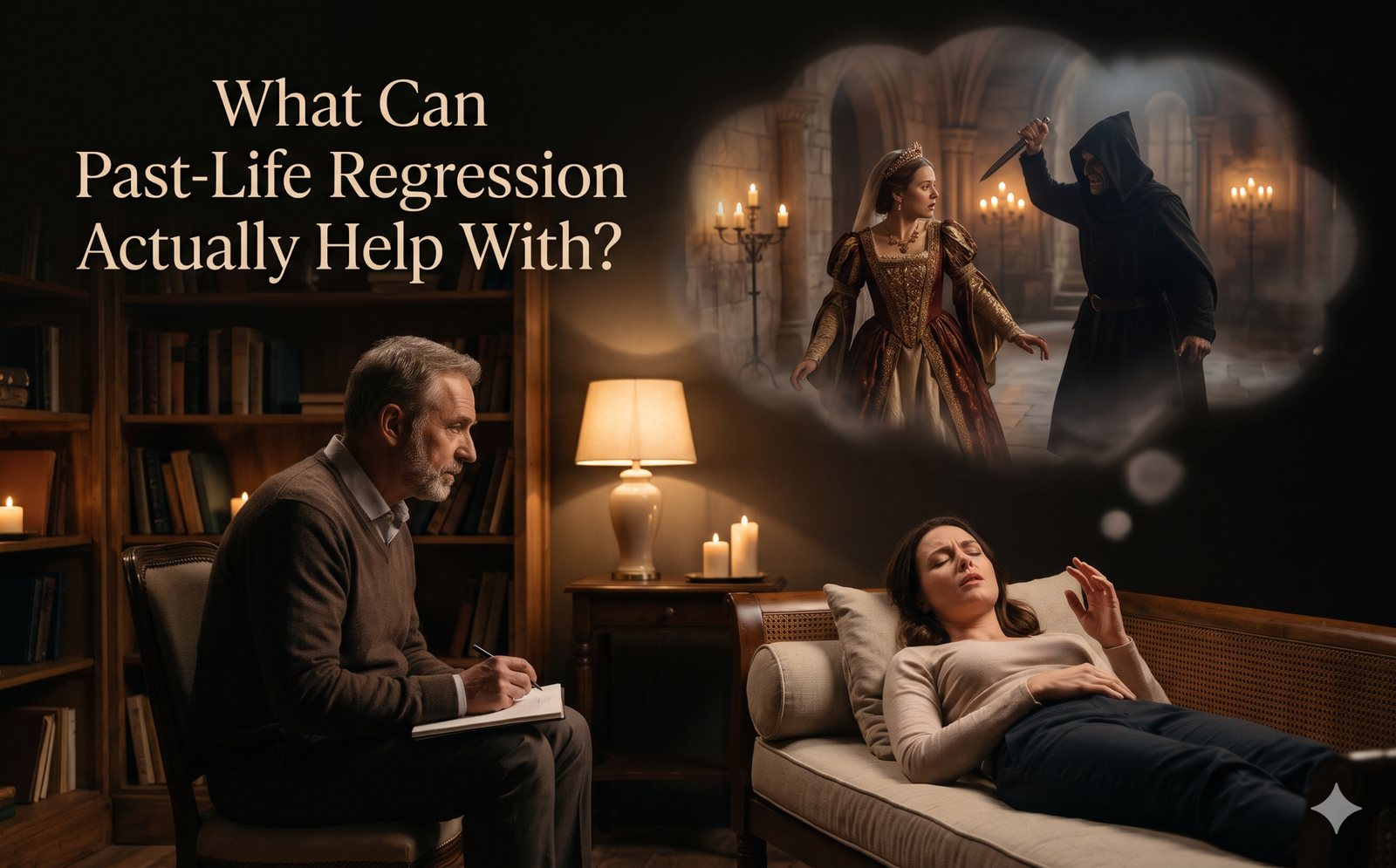
Past-life regression tends to help most when something keeps repeating and it doesn’t trace back to any clear memory from this lifetime: a fear with no obvious origin, a pull toward a person or place you can’t explain, or a pattern in relationships that shows up no matter who you’re with. A session uses a relaxed, highly focused hypnotic state to let images and associations surface, which you and the practitioner then work through together rather than treat as settled historical fact. It isn’t a diagnostic tool, and it isn’t a replacement for therapy when something clinical is going on, though many people use it alongside other support. For the right kind of stuck pattern, it can genuinely move something that talking alone hasn’t.
Key Takeaways
- Past-life regression works best on patterns that repeat without a present-life explanation: specific phobias, recurring relationship dynamics, or an inexplicable pull toward certain people or places.
- A session uses hypnosis to reach a relaxed, focused state. It is not sleep and not unconsciousness, and you stay aware and in control the entire time.
- Whether the images that come up are literal past lives or the mind’s own symbolic way of surfacing unresolved material is genuinely debated, even among practitioners, and you don’t need to settle that question before a session helps.
- It works as a complement to other support, not a replacement for therapy, and it is not appropriate as the only treatment for a diagnosed clinical condition.
- Most people need one to three sessions to get real clarity on a specific pattern, rarely an open-ended series.
- At Blessings Revitalize, regression work is done through a structured hypnotic framework rather than an unscripted guided meditation, which matters more than it sounds for how reliably it actually surfaces something useful.
What Kinds of Problems Does Past-Life Regression Actually Address?
The people who get the most out of this work usually describe the same shape of problem before they ever book a session. Something keeps happening, and they have already looked for the obvious cause and come up empty. A fear of water with no childhood incident behind it. An immediate, visceral discomfort around a specific type of person, met within minutes of meeting them, before any actual interaction. A pattern in relationships, drawn to the same dynamic over and over, that outlasts every partner and every city.
These are the cases where the regression exploration work Sandeep does tends to be worth trying. It is less useful for vague dissatisfaction or general stress, where more direct tools usually get there faster. The clearer and more specific the recurring thing is, the more a session has to actually work with.
How Is This Different From Hypnotherapy for Anxiety or Habits?
Most hypnotherapy, for smoking, for weight habits, for everyday anxiety, works on the present-day thought and behavior pattern directly. Regression work takes a different route. Instead of addressing the fear of flying by rehearsing calm responses to turbulence, a regression session goes looking for where that fear seems to originate, wherever the mind actually takes it, and lets whatever surfaces get processed rather than managed around.
That is a slower, less predictable tool, and it is not the right first choice for most everyday anxiety or habit work, where direct hypnotherapy usually resolves things in fewer sessions. For a full walkthrough of what a regression session is actually like from start to finish, including how the hypnotic state is guided, the session-by-session breakdown here covers that ground in more detail than this piece does.
Is It Really the Past, or Is Your Mind Doing Something Else?
This is worth being straightforward about rather than glossing over. Nobody can prove, in a courtroom sense, that the images a client sees during regression are literal memories from an actual previous life rather than the mind’s own symbolic language for something unresolved in this one. Sandeep, who has worked in regression exploration and hypnotherapy in Delhi NCR for over two decades as a BSH-certified hypnotherapist, tells clients this plainly before a session rather than after: whether the content is literal or metaphorical, people routinely report the same fear or pattern losing its grip once it has been brought up, looked at, and processed. The mechanism is debated. The practical result, for a meaningful number of people, is not.
This also connects to something the body itself seems to hold onto, independent of whether you can consciously explain it. The piece on how unresolved experience shows up physically covers a related idea from a different angle, and the overlap is worth knowing about if a pattern you’re trying to understand has a strong physical or somatic component rather than a purely emotional one.
Who Should Probably Skip This, At Least for Now?
Regression work is not the right starting point for everyone, and it is worth saying so directly. If what’s going on looks more like ongoing low mood, panic that is interfering with daily function, or anything where a clinical diagnosis is already on the table or seems likely, the right first step is a doctor or mental health professional, not a hypnotherapy session. This is complementary work, not a substitute for medical or mental health treatment, and a responsible practitioner will say exactly that rather than position regression as a cure-all. For people who are simply curious, skeptical, or looking for closure on something specific and are not managing an active clinical condition, it is generally a safe and low-risk thing to try.
Frequently Asked Questions
Do I have to believe in past lives for this to work?
No. Plenty of clients approach it from genuine skepticism and still find the process useful, since the value tends to come from processing whatever surfaces, not from first accepting a particular belief about where it came from.
How many sessions does it usually take?
Most people get meaningful clarity in one to three sessions focused on a specific pattern or fear. It is not typically an ongoing, open-ended series the way some other therapeutic work can be.
Can past-life regression bring up upsetting memories or emotions?
Sometimes, yes, and a well-run session is built to handle that rather than rush past it. You remain conscious and in control throughout, and the practitioner’s job includes helping you stay grounded if something intense comes up.
Is this the same thing as regular hypnotherapy?
It uses the same hypnotic technique, a relaxed, highly focused state, but points it at a different kind of question. Regular hypnotherapy for habits or anxiety works on present-day behavior directly, while regression exploration goes looking for where a pattern seems to originate.
Can it help with physical symptoms, not just emotional ones?
Some clients report physical tension or sensation tied to a pattern easing after a session, but this is not a medical treatment and should never replace seeing a doctor for a physical symptom that needs its own diagnosis.
Is there scientific proof that past lives are real?
No, and a straightforward practitioner will tell you that upfront rather than overstate the evidence. What is better supported is that the process of surfacing and working through whatever comes up, regardless of its literal origin, often brings real relief.
If there’s a pattern you’ve been trying to figure out for a while and nothing direct has touched it yet, that’s usually the sign it’s worth exploring rather than something to just keep living around. You can book a session with Sandeep and talk through whether regression work actually fits what you’re dealing with before committing to anything.
Written by Sandeep Jain, Reiki Grand Master (GHSC-UK) and BSH-certified hypnotherapist, founder of Blessings Revitalize, Delhi NCR.