Quick Answer: Mikao Usui (1865–1926) was a Japanese spiritual teacher who developed Reiki after a period of fasting and meditation on Mount Kurama in the early 1920s. He founded the Usui Reiki Ryoho system in Tokyo in April 1922 and personally taught more than 2,000 students before his death. Nearly every Reiki lineage practiced today, including the training a modern practitioner completes, traces back to him in one way or another.
If you’ve ever booked a Reiki session and wondered where any of this actually comes from, you’re asking a fair question. Reiki can sound abstract until you learn it has a real founder, a real place where it started, and a fairly well-documented history behind it, not just a vague “ancient practice” label.
Who Was Mikao Usui, Exactly?
Usui was born on August 15, 1865, in Taniai village in Japan’s Gifu Prefecture, into a family with samurai roots on his father’s side. By most accounts he was well educated and widely read, drawn to subjects like medicine, psychology, and various religious traditions well before he developed Reiki. He married Sadako Suzuki, and the couple had two children.
One claim that circulates a lot online is that Usui held a doctorate from the University of Chicago and traveled extensively studying comparative religion and medicine. It’s worth being upfront here: there’s no actual evidence he ever attended the University of Chicago, and this detail is now generally treated as part of the legend that grew up around him rather than a documented fact (source). It doesn’t take anything away from what he actually built, it’s just worth knowing which parts of the story are solid and which are folklore.
What Actually Happened on Mount Kurama
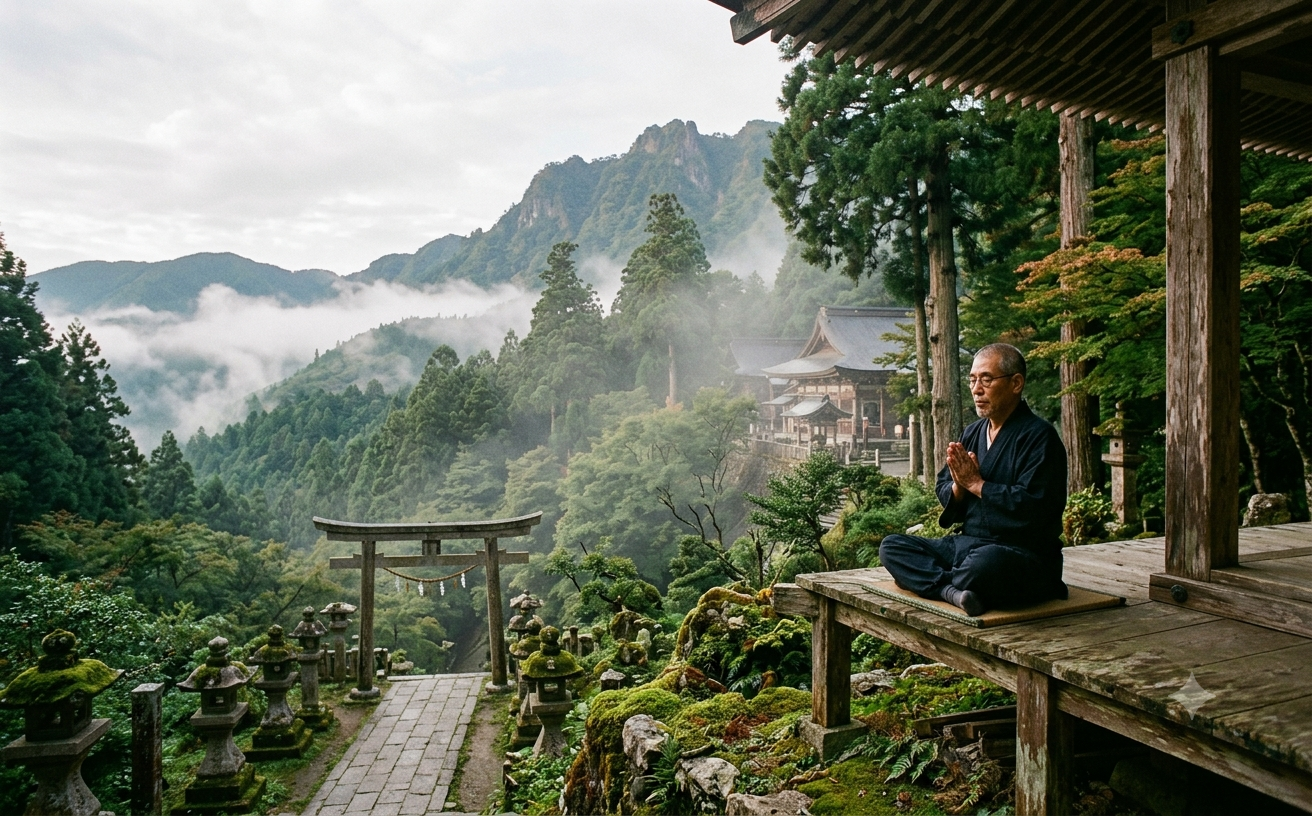
The part of the story most people are really asking about is the mountain. In the early 1920s, Usui undertook a 21-day retreat of fasting and meditation on Mount Kurama, a mountain northwest of Kyoto that already had a long history as a site for Buddhist and ascetic practice. It was during, or at the end of, this retreat that Usui reported the experience that became the foundation of Reiki: a direct, felt sense of universal life force energy, and a method for channeling it to support healing.
This is the origin story that shows up in almost every Reiki lineage’s teaching, though the exact details of what happened on the mountain vary depending on who is telling it. What’s well documented is what he did immediately afterward: he didn’t keep it to himself.
How Usui Reiki Ryoho Began
In April 1922, Usui founded a school in Harajuku, Tokyo, to formally teach what he called Reiki Ryoho, Reiki healing method. According to accounts from his own memorial stone, students came “from far and near” to study with him.
The practice got a very real, very public test the following year. After the Great Kanto earthquake devastated Tokyo in September 1923, Usui and his students reportedly treated large numbers of injured and traumatized survivors, which did a great deal to establish Reiki’s reputation beyond his original circle of students. By the time he died in 1926, after suffering a stroke while traveling to teach, he had personally trained more than 2,000 people, an unusually large number for a practice that started with one person’s experience on a mountain.
From Usui to the Rest of the World
Usui’s Reiki didn’t stay only in Japan. It spread through a small number of his senior students, and the lineage most Western practitioners are trained in today traces through Hawayo Takata, a Hawaii-born teacher who studied Reiki in Japan and later brought it to the United States. Along the way, the practice picked up some adaptations, including Christian framing added to make it more accessible to Western students, layered alongside its original Buddhist and Japanese roots.
That’s part of why Reiki looks slightly different depending on where and who you learn it from. The lineage, the hand positions, the exact language used, all of that has evolved over a century of teaching. But the underlying idea Usui articulated in Tokyo in 1922, that a trained practitioner can channel and direct life force energy to support someone else’s healing, is still the same idea being practiced in sessions today.
Why Any of This Should Matter Before You Book a Session
Honestly, most people don’t need to know Reiki history to benefit from a session. But it’s a reasonable thing to want to know before you commit to a practice, especially an energy-based one: is there a real, traceable origin here, or is this just a modern wellness trend with a nice name?
Usui’s story is the answer. Reiki has a founder, a founding date, a documented near-death recovery use case (the 1923 earthquake response), and a century of continuous teaching lineage behind it. It’s also worth knowing what your specific practitioner’s training actually involved, since Reiki certification standards vary a lot depending on who’s teaching. If you’re curious what a Reiki Grand Master credential actually means in practice, that’s something we’ve broken down in plain terms in our piece on Sandeep Jain’s own hypnotherapy and Reiki credentials.
If you want to experience what Usui’s method actually feels like in a modern, remote setting, you can read more about our Reiki Healing Online sessions.
A Few Quick Questions People Usually Have
Was Mikao Usui a real historical person? Yes. He’s a documented figure with a known birth date, death date, and a memorial stone in Tokyo that several of his students helped fund, which is itself part of how historians have pieced his biography together.
Did Usui practice medicine? Not in a licensed, clinical sense. His background was more in spiritual study and comparative religion than formal medicine, which is part of why Reiki has always positioned itself as a complementary practice rather than a substitute for medical care.
Is the Mount Kurama story historically confirmed? The retreat itself is well attested. The precise details of the spiritual experience he had there are, understandably, harder to verify and are passed down mostly through oral teaching, so different lineages describe it slightly differently.