Key Takeaways
- High achievement can be driven by survival patterns, not ambition.
Over-achieving, people-pleasing, and perfectionism often originate from early emotional conditioning rather than conscious career strategy. - Career plateaus at senior levels are frequently emotional, not skill-based.
Many professionals experience stalled career flow due to unresolved nervous-system patterns rather than a lack of competence or effort. - Perfectionism and people-pleasing create hidden emotional career blocks.
These patterns drain energy, slow decision-making, and increase burnout despite outward success. - Inner child healing functions as a high-performance systems upgrade.
When positioned correctly, it removes outdated emotional drivers instead of reducing drive or ambition. - Healing the achiever archetype preserves edge while eliminating exhaustion.
Professionals retain discipline and responsibility while releasing constant pressure to prove worth. - True career flow emerges when survival-based motivation is no longer in control.
With regulated nervous-system functioning, effort aligns more easily with outcome. - Inner child healing for professionals is increasingly used alongside executive coaching.
In 2026, it is viewed as an amplifier of leadership clarity, not a therapeutic detour. - Sustainable success requires internal safety, not increased self-pressure.
Removing emotional friction restores clarity, resilience, and long-term performance capacity.
| Pattern | Survival-Led Success (The Trap) | Flow-Led Success (The Upgrade) |
| Primary Driver | Fear of inadequacy / Proving worth | Internal safety / Value-alignment |
| Energy State | High-tension, “Always On” | Calm focus, “Regulated Drive” |
| Decision Making | Urgency-based / People-pleasing | Clarity-based / Boundary-aware |
| Burnout Risk | Critical / Inevitable | Low / Sustainable |
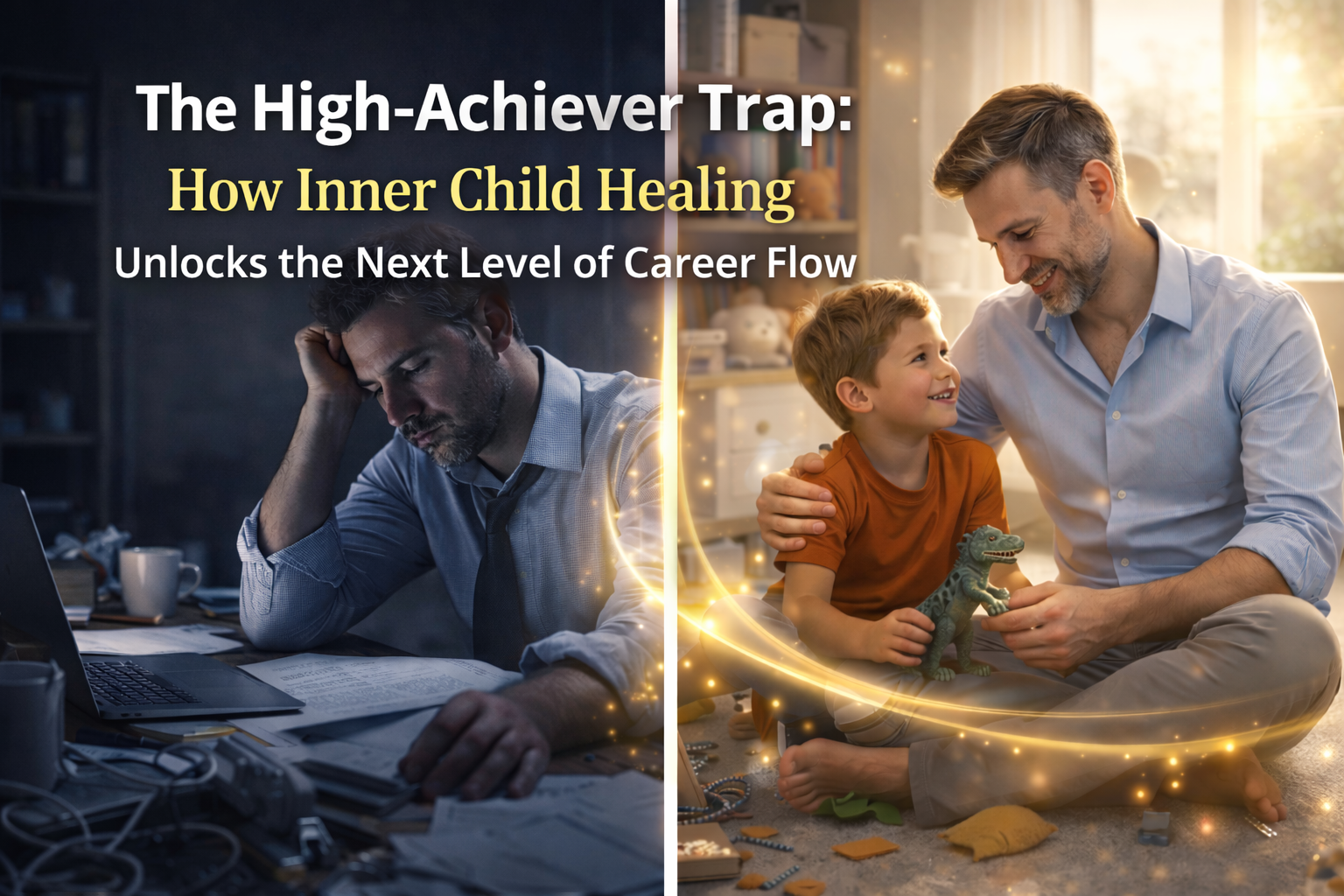
Inner child healing for professionals is emerging in 2026 as a practical, high-performance upgrade-not a therapeutic detour-for leaders, founders, and ambitious professionals who feel stuck despite doing everything “right.” When drive, discipline, and perfectionism are powered by unhealed childhood survival patterns, success becomes exhausting. Inner child healing for professionals helps remove emotional career blocks at the root level, allowing effort, clarity, and opportunity to flow with far less resistance.
Why Inner Child Healing Improves Career Flow for High Achievers
Inner child healing helps high-achieving professionals remove unconscious survival patterns-such as over-achieving, people-pleasing, and perfectionism-that create emotional career blocks. By regulating the nervous system and releasing outdated emotional drivers, professionals experience clearer decision-making, reduced burnout, and improved career flow without sacrificing ambition.
The Success Paradox High Achievers Don’t Talk About
On paper, everything looks fine.
The role is senior. The income is stable. The résumé keeps growing.
Yet internally, many high-performing professionals describe the same quiet reality:
- Constant pressure to prove worth
- Difficulty slowing down without guilt
- Anxiety around mistakes, even small ones
- Feeling responsible for everyone and everything
This is the high-achiever trap-a state where competence and success coexist with chronic mental tension, emotional fatigue, and stalled career flow.
In leadership-heavy environments like Delhi-NCR, Gurgaon, and other global corporate hubs, this pattern is increasingly common among professionals in their 30s, 40s, and early 50s. The missing piece is rarely skill or strategy. It’s often emotional wiring formed much earlier in life.
Over-Achieving as a Trauma Response (Not a Personality Trait)
One of the most misunderstood ideas in modern performance psychology is that over-achieving is always healthy ambition.
In reality, over-achiever trauma response patterns are often rooted in childhood experiences where:
- Approval was conditional
- Safety came from performance
- Love was linked to usefulness
- Mistakes had emotional consequences
For a child, adapting to these conditions is intelligent.
For an adult professional, the same pattern becomes costly.
How This Shows Up at Work
- You say yes automatically, then resent it later
- You work harder instead of asking for support
- You feel uneasy delegating
- You tie self-worth to output, not impact
This is not weakness. It’s survival energy still running the system.

People-Pleasing at Work: The Invisible Energy Drain
People-pleasing is often praised as being “easy to work with” or “collaborative.” But underneath, it usually carries fear-based motivation.
Common workplace people-pleasing behaviors include:
- Avoiding difficult conversations
- Over-preparing to prevent criticism
- Reading between the lines excessively
- Prioritizing harmony over clarity
Over time, this creates emotional career blocks-not because others are difficult, but because your nervous system never fully relaxes.
In high-stakes professional roles, this leads to burnout masked as dedication.
Perfectionism at Work: When Excellence Becomes Exhausting
Perfectionism at work is rarely about standards. It’s about emotional safety.
High achievers often believe:
- “If I do it perfectly, I won’t be criticized.”
- “If I stay sharp, I won’t be rejected.”
- “If I’m indispensable, I’ll be secure.”
This internal contract fuels productivity early in a career-but later becomes a bottleneck.
The Cost of Long-Term Perfectionism
- Slower execution due to overthinking
- Difficulty innovating or taking risks
- Leadership fatigue
- Reduced creative flow
The achiever archetype outgrows its original survival role-but doesn’t know how to stand down.
Why Traditional Career Advice Stops Working
Most leaders reach a point where productivity hacks and leadership frameworks stop yielding results. This is the Emotional Glass Ceiling. You can have the best “software” (strategy), but if your “hardware” (the nervous system) is stuck in a 20-year-old survival loop, the system will crash.
In corporate hubs like Delhi-NCR and Gurgaon, the pressure to remain “unshakeable” often forces leaders to suppress the very emotions that drive intuition and creativity.
Most career growth advice focuses on:
- Time management
- Leadership frameworks
- Communication strategies
- Mindset shifts
These tools are effective-but only when the nervous system is not constantly scanning for threat.
For professionals whose motivation is tied to early survival patterns, no amount of productivity hacking removes the underlying tension. This is where inner child healing for executives and senior professionals reframes growth entirely.
Reframing Inner Child Work as a High-Performance Upgrade
Inner child work is often misunderstood as emotional therapy or vulnerability-focused healing. That framing turns off many high performers.
A more accurate description is this:
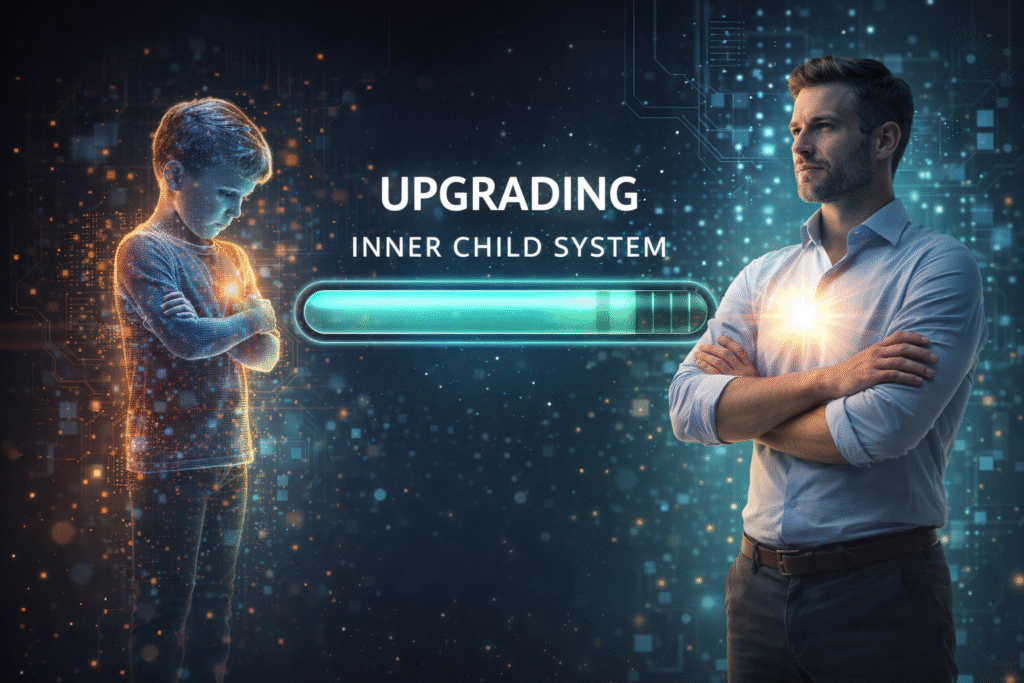
Inner child healing is an emotional systems upgrade that removes outdated survival code from your professional operating system.
It doesn’t make you softer.
It makes you clearer, steadier, and more resilient.
How Inner Child Healing Unlocks Career Flow
When the nervous system stops operating from survival, something important happens: effort aligns with outcome.
Professionals who engage in inner child work often report:
- Improved decision-making without urgency
- Reduced emotional reactivity at work
- Better boundary setting without guilt
- Increased confidence with less effort
This isn’t about working less. It’s about working without internal resistance.
Healing the Achiever Archetype
The achiever archetype is not the problem. It’s outdated leadership of your inner world.
Healthy Achiever Traits
- Discipline
- Focus
- Ambition
- Responsibility
Unhealthy Achiever Patterns
- Self-worth tied to output
- Chronic pressure to prove value
- Fear of slowing down
- Emotional suppression
Healing the achiever archetype means keeping the strengths while releasing the pressure.
That’s what creates sustainable success.
Emotional Career Blocks: The Real Bottleneck at Senior Levels
At early career stages, effort drives results.
At senior levels, internal regulation determines flow.
Emotional career blocks often show up as:
- Hesitation before major decisions
- Plateauing despite strong performance
- Loss of motivation without logic
- Difficulty enjoying success
These blocks aren’t skill-based. They’re nervous-system-based.
Inner child healing addresses these patterns where they originate-before they manifest as burnout or disengagement.
Why This Matters for Leaders in High-Pressure Environments
In fast-paced corporate regions like Delhi-NCR and Gurgaon, professionals are expected to:
- Stay emotionally controlled
- Deliver consistently
- Absorb pressure without visible strain
Inner child wounds don’t disappear in these environments-they intensify.
That’s why many leaders are turning to non-invasive, private approaches like inner child healing sessions delivered online, without the need to step away from responsibility.
Who Inner Child Healing for Professionals Is (and Isn’t) For
This work is designed for:
- Leaders, founders, and senior professionals
- High achievers experiencing burnout despite success
- Professionals stuck at a career plateau without logical reasons
This work is not for:
- Replacing psychotherapy or mental health care
- Crisis intervention or trauma processing
- Passive motivation or mindset shortcuts
This boundary increases trust and prevents misclassification.
What Inner Child Healing for Professionals Actually Looks Like
This work is not about reliving the past or assigning blame.
It focuses on:
- Identifying unconscious emotional drivers
- Releasing outdated coping mechanisms
- Supporting nervous system regulation
- Rebuilding internal safety
Sessions are structured, grounded, and forward-facing-particularly suited to analytical, results-oriented professionals. For many professionals, inner child healing is engaged through structured, one-to-one sessions delivered privately and online. This allows leaders to work with emotional patterns discreetly, without stepping away from responsibility or identity. The emphasis remains practical, regulated, and forward-focused.
Why This Is Not “Soft Work”
High performers often resist this work because it doesn’t look tangible. Yet its impact is measurable in:
- Decision clarity
- Energy availability
- Leadership presence
- Reduced burnout symptoms
In 2026, inner child healing is increasingly positioned alongside executive coaching, nervous system regulation, and energetic calibration—not as an alternative, but as an amplifier.
The Shift From Pushing to Flow
Career flow isn’t passive.
It’s the absence of internal friction.
When survival energy no longer fuels performance, professionals often experience:
- Faster recovery from stress
- Improved intuition in leadership
- Less emotional carryover between work and home
- Greater satisfaction without reducing ambition
This is what inner child healing for professionals ultimately unlocks.
Common Myths That Hold High Achievers Back
Myth 1: “If I heal this, I’ll lose my drive.”
Reality: You lose the anxiety, not the ambition.
Myth 2: “I don’t have childhood trauma.”
Reality: Trauma isn’t about events—it’s about adaptation.
Myth 3: “This is therapy, not performance.”
Reality: Emotional regulation is a performance skill.
Signs Inner Child Work May Be Your Next Growth Lever
- You’re successful but constantly tense
- Rest doesn’t fully restore you
- You feel responsible for everything
- You struggle to enjoy achievements
- You’ve outgrown hustle—but don’t know what replaces it
These are not signs of weakness. They’re signs of evolution.
Ethical Perspective
Inner child healing is a complementary wellness approach.
It does not replace psychotherapy, mental health care, or medical support.
Its role is to support emotional balance, regulation, and internal alignment—especially for professionals navigating sustained pressure.
Frequently Asked Questions
Can inner child healing help with career stagnation?
Yes. Many professionals experience career stagnation due to unresolved emotional patterns rather than skill gaps. Inner child healing addresses these internal blocks at the nervous-system level.
Is inner child healing suitable for logical or analytical professionals?
Yes. Sessions are structured, grounded, and results-oriented, making them suitable for analytical, leadership-driven personalities.
How is inner child healing different from coaching?
Coaching focuses on strategy and behavior. Inner child healing addresses the emotional drivers behind behavior, allowing coaching outcomes to stick.
Is inner child healing for professionals appropriate for executives?
Yes. It is increasingly used by leaders seeking sustainable performance without burnout.
Will this reduce ambition?
No. It removes anxiety-driven urgency while preserving drive.
Can this be done privately?
Yes. Online sessions allow discretion and flexibility.
Final Thought: The Real Next Level
The next level of career growth rarely comes from working harder.
It comes from removing what’s draining you underneath success.
Inner child healing doesn’t slow you down.
It upgrades the system that’s been carrying you this far.
If you’re ready to shift from pushing to flowing,
contact Blessings Revitalize that offers guided work designed to restore balance, clarity, and sustainable success-without burnout.
Explore a calmer, more aligned way forward.